
Tech Neck: How Screen Time Can Affect Your Neck and Posture
Phones, computers, tablets, gaming devices—we spend more time looking at screens than ever before.
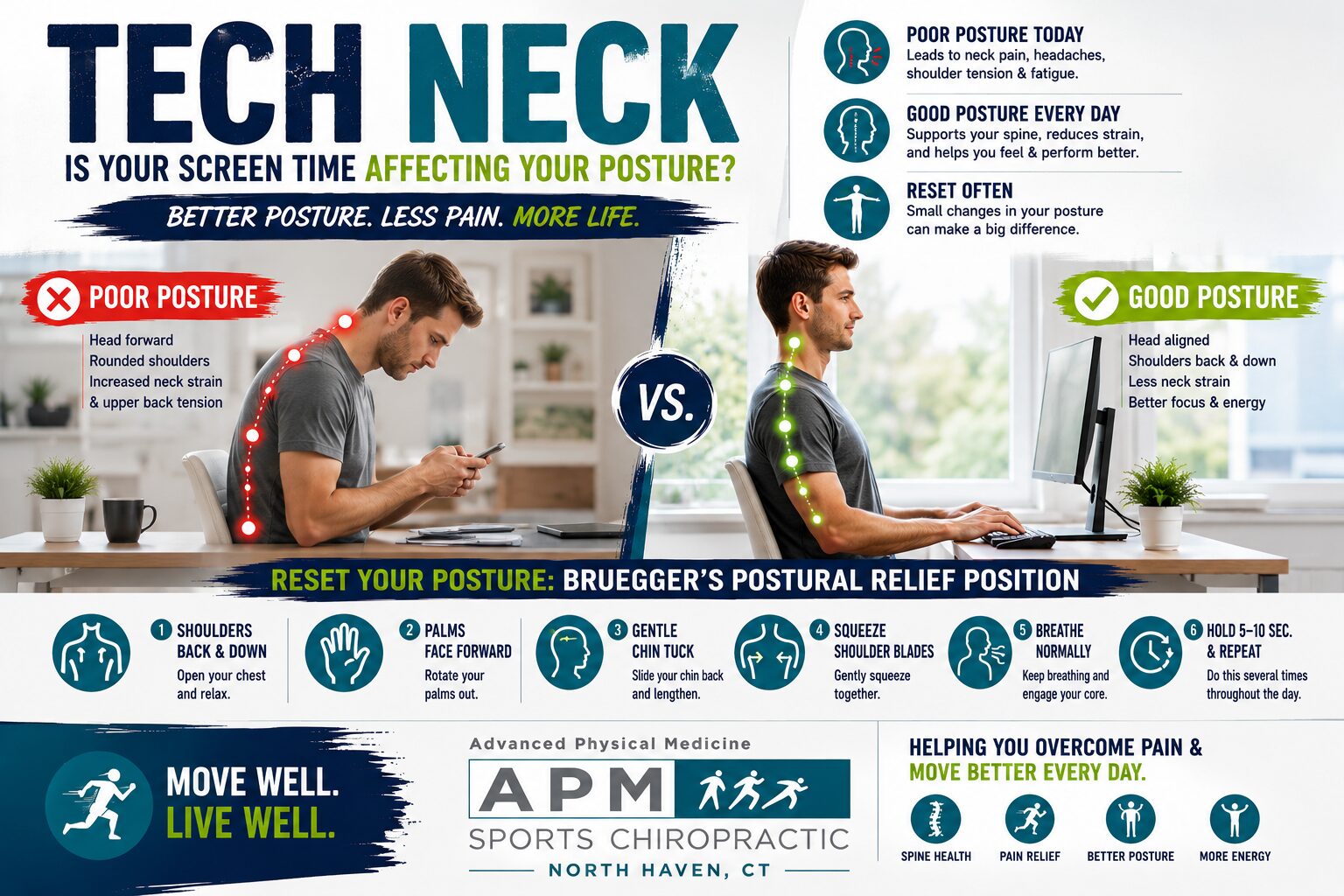
Unfortunately, all that screen time can also change the way we sit and stand. If you’ve ever caught yourself looking down at your phone with your head forward, shoulders rounded, and upper back hunched, you’ve experienced the posture commonly associated with tech neck.
At APM Sports Chiropractic in North Haven, CT, we frequently see adults, teenagers, and young athletes dealing with neck pain, headaches, tight shoulders, and stiffness that may be related to prolonged screen use and poor posture.
The solution isn’t to stop using technology. Instead, it’s about becoming more aware of your posture, moving regularly, and giving your body a break from the same position.
What Is Tech Neck?
You may have heard the term “text neck” in the past.
Text neck originally referred to the forward-head position people develop while looking down at their phones. Today, tech neck is a broader term because phones aren’t the only devices keeping us in that position.
Tech neck can happen while:
- Working at a computer
- Texting or scrolling on a phone
- Using a tablet
- Gaming
- Reading on an e-reader
- Doing homework on a laptop
- Watching videos
We even see similar posture while people are driving.
The common factor is spending extended periods with your head forward, shoulders rounded, and upper back hunched.
Why Can Tech Neck Cause Neck Pain?
Your head is meant to sit relatively balanced over your shoulders.
When your head moves forward and stays there for long periods, the muscles of your neck, shoulders, and upper back have to work harder to support it.
Over time, this increased demand can contribute to muscle fatigue, stiffness, and discomfort.
People with tech neck may experience:
- Neck pain or stiffness
- Headaches
- Tight shoulders
- Upper-back discomfort
- Reduced neck mobility
- Muscle tension around the base of the skull
- Shoulder discomfort
Poor posture doesn’t automatically mean you’ll develop pain, but spending hours in the same position without moving can certainly contribute to the problem.
Tech Neck Isn’t Just an Adult Problem
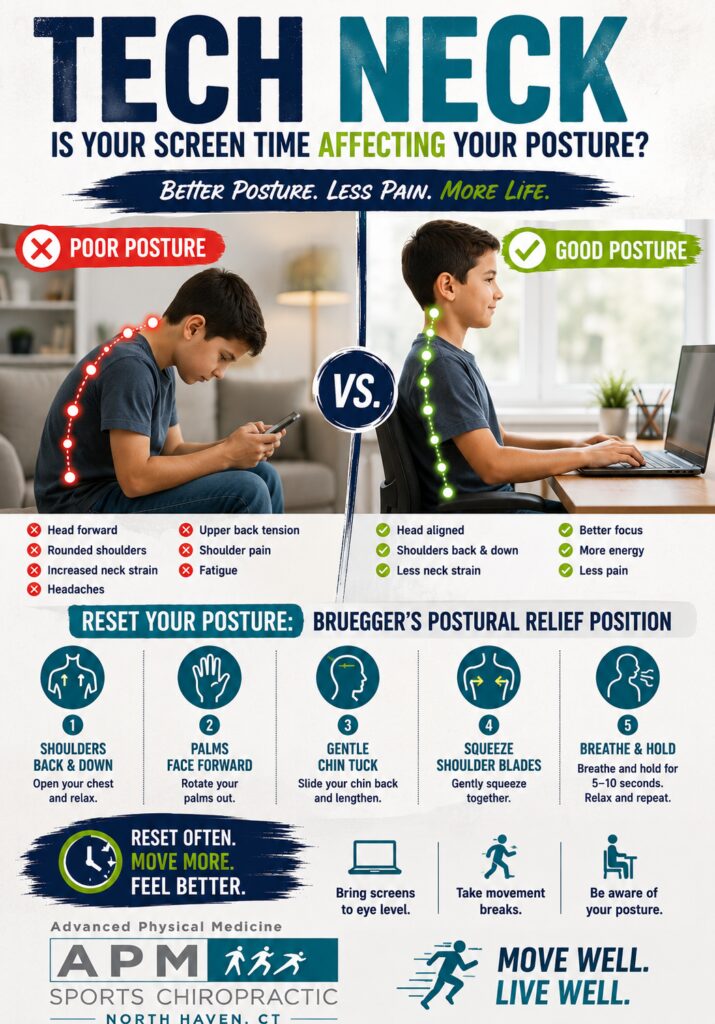
We’re seeing posture issues in younger patients as well.
Think about how much time kids and teenagers spend using technology between school and home.
Their day may include laptops at school, tablets for homework, phones, gaming systems, and streaming devices.
For student athletes, that can be especially important. They may spend hours sitting at school and looking at screens before heading directly to a practice or game where they’re asking their bodies to perform at a high level.
Parents should pay attention if their child frequently complains about:
- Neck pain
- Headaches
- Shoulder tightness
- Upper-back discomfort
- Stiffness after using a computer or phone
It’s also worth simply looking at their posture while they’re using their devices.
How Can You Help Prevent Tech Neck?
You don’t need perfect posture every second of the day.
In fact, one of the most important things you can do is simply change positions and move more often.
Try these simple strategies:
Bring Your Screen Up
Instead of constantly dropping your head toward your phone, bring the device closer to eye level when possible.
For desktop work, position your monitor so you aren’t repeatedly looking significantly downward.
Take Movement Breaks
Don’t stay locked into one position for hours.
Stand up, walk around, stretch, and reset your posture periodically throughout the day.
Pay Attention to Your Shoulders
When you’re working or scrolling, check whether your shoulders have started creeping forward.
Gently bring them back and down into a relaxed position.
Don’t Forget About Your Head
Try to keep your head more comfortably aligned over your shoulders instead of allowing it to drift farther and farther forward.
Try the Bruegger’s Postural Relief Position
One of our favorite exercises for people who spend significant time on computers and phones is the Bruegger’s Postural Relief Position.
It’s simple, requires no equipment, and can be performed sitting or standing.
Here’s how to do it:
1. Sit or stand tall.
Start by getting out of your slouched position.
2. Bring your shoulders back and down.
Don’t shrug. Think about gently moving your shoulders away from your ears.
3. Turn your palms outward.
Rotate your arms so your palms face forward. This helps open the chest and counter the rounded-shoulder position.
4. Gently squeeze your shoulder blades together.
You don’t need to force the movement.
5. Perform a chin tuck.
Keep your eyes facing forward and gently bring your chin straight backward, almost as if you’re making a small double chin.
You may feel a gentle stretch through the back of your neck and near the base of your skull.
6. Breathe and hold for 5–10 seconds.
Relax and repeat.
Try performing a few repetitions periodically throughout your work or school day.
Posture Awareness Is the Bigger Goal
Bruegger’s Postural Relief is helpful, but no single exercise can completely undo hours of inactivity.
The bigger goal is body awareness.
Every so often, check yourself:
Where is my head?
Are my shoulders rounded?
Have I moved recently?
Have I been staring down at this screen for the last hour?
Those little reminders can help you develop better habits.
Think of the exercise as a posture reset, not a requirement to maintain one rigid “perfect” posture all day.
When Should You Get Neck Pain Checked?
If changing positions, taking breaks, and performing gentle exercises aren’t helping, there may be more going on than posture alone.
Neck pain can have many different causes, which is why it’s important not to assume every case is tech neck.
Consider having your neck evaluated if you have:
- Persistent or worsening neck pain
- Frequent headaches
- Significant loss of neck movement
- Pain following an injury
- Pain traveling into the shoulder or arm
- Numbness, tingling, or weakness
An evaluation can help determine what’s contributing to your symptoms and what type of treatment may be appropriate.
Chiropractic Care for Tech Neck in North Haven, CT
At APM Sports Chiropractic in North Haven, CT, we take a movement-based approach to neck pain and posture problems.
Depending on your specific condition, your treatment plan may include:
- Chiropractic adjustments
- Instrument Assisted Soft Tissue Mobilization (IASTM)
- Soft tissue therapy
- Stretching and mobility exercises
- Postural correction exercises and education
- Strengthening and rehabilitation
- Class IV laser therapy when appropriate
The goal isn’t simply to temporarily reduce pain.
We want to improve movement, address contributing factors, and give you strategies you can use outside the office to help keep the problem from continually returning.
Don’t Let Your Technology Become a Pain in the Neck
Technology is part of everyday life, and that’s not changing anytime soon.
But the way you use it can change.
Bring your screen up. Move throughout the day. Keep your shoulders relaxed. Pay attention to your head position. And give your posture regular resets.
If you’re experiencing persistent neck pain, headaches, or upper-back tension and think tech neck may be contributing, contact APM Sports Chiropractic in North Haven, CT to schedule an evaluation.
Be The First To Comment