
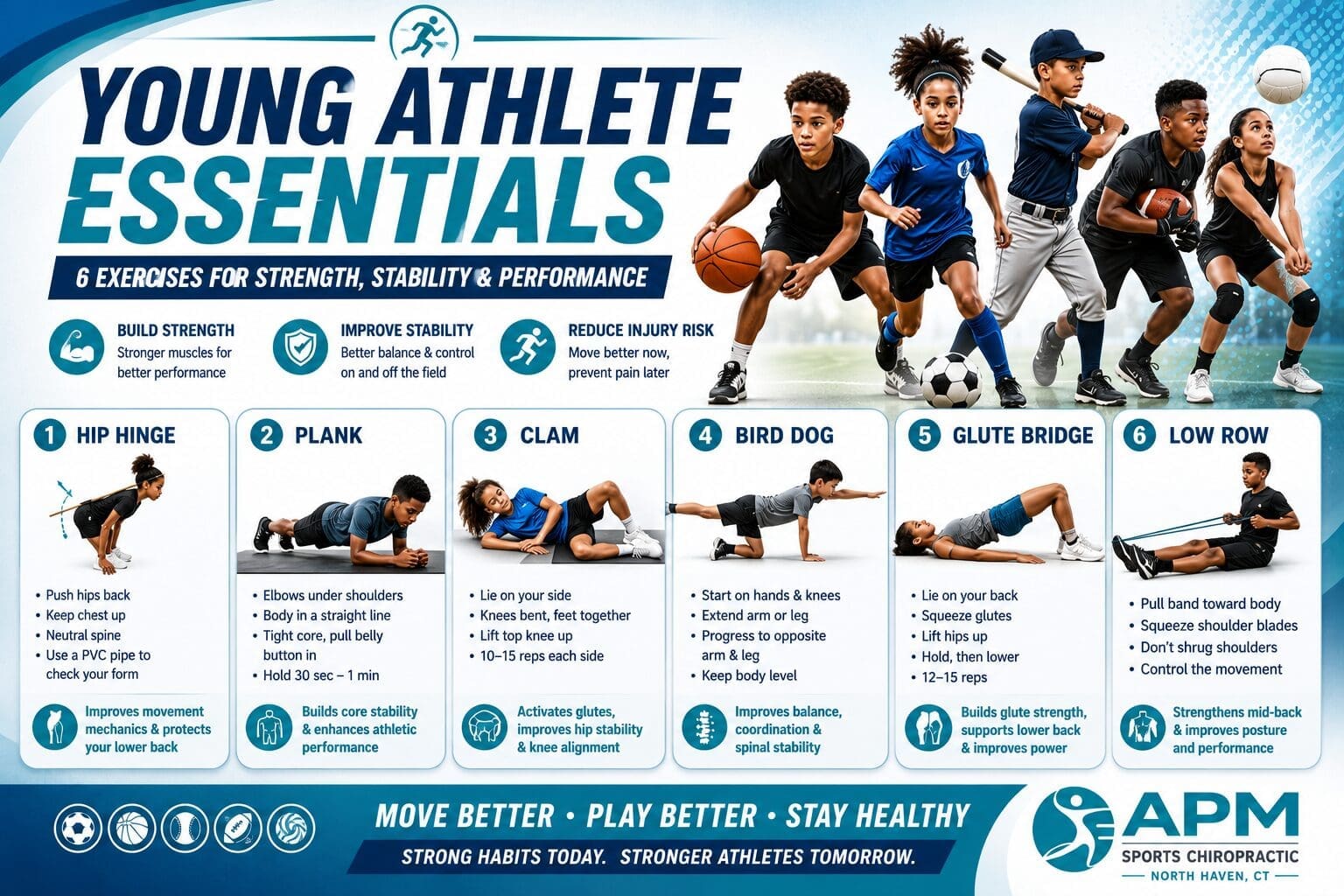
6 Essential Exercises for Young Athletes to Improve Performance and Prevent Injuries
Whether your child plays soccer, basketball, baseball, football, volleyball, lacrosse, or another sport, learning proper movement patterns is one of the best ways to improve athletic performance and reduce the risk of injury.
At APM Sports Chiropractic in North Haven, CT, we believe young athletes should master foundational movement patterns before progressing to advanced strength and conditioning programs. These exercises help build strength, stability, coordination, balance, posture, and body awareness—skills that carry over to nearly every sport.
Here are six essential exercises for young athletes that can help improve performance and support long-term athletic development.
1. Hip Hinge
The hip hinge is one of the most important movement patterns a young athlete can learn.
Many athletes bend from their lower back instead of their hips, which places unnecessary stress on the spine and can increase injury risk. Learning to hinge properly helps athletes generate power while protecting their backs.
How to Perform a Hip Hinge
- Stand with your feet shoulder-width apart.
- Slightly unlock your knees.
- Keep your chest up and shoulders back.
- Push your hips backward while maintaining a neutral spine.
- Return to the starting position.
A great way to check your form is to hold a PVC pipe against your back. The pipe should remain in contact with your head, upper back, and hips throughout the movement.
Benefits
- Improves movement mechanics
- Develops stronger glutes and hamstrings
- Helps protect the lower back
- Builds a foundation for running, jumping, and lifting
2. Plank
A strong core is essential for every athlete.
The plank teaches athletes how to create stability through their trunk while maintaining proper posture and alignment.
How to Perform a Plank
- Support yourself on your elbows and toes.
- Keep your body in a straight line from head to heels.
- Avoid letting your hips sag or rise.
- Pull your belly button gently toward your spine.
- Continue breathing normally.
Start with 20–30 seconds and gradually work up to one minute.
Benefits
- Improves core stability
- Enhances athletic performance
- Supports proper posture
- Helps reduce injury risk
3. Clam Exercise
The clam exercise is one of the best ways to activate and strengthen the glute muscles, which play a critical role in athletic movement.
Strong glutes help stabilize the hips and knees during running, jumping, and cutting activities.
How to Perform a Clam
- Lie on your side with your knees bent.
- Keep your feet together.
- Raise your top knee toward the ceiling.
- Pause briefly.
- Slowly return to the starting position.
Perform 10–15 repetitions on each side.
Benefits
- Strengthens the glute muscles
- Improves hip stability
- Supports proper knee alignment
- Helps reduce the risk of lower extremity injuries
4. Bird Dog
The bird dog is an excellent exercise for developing balance, coordination, and core control.
It teaches athletes how to stabilize their spine while moving their arms and legs independently.
How to Perform a Bird Dog
- Start on your hands and knees.
- Extend one arm straight in front of you.
- Return to the starting position and alternate sides.
- Progress by extending one leg behind you.
- Eventually perform opposite arm and opposite leg simultaneously.
Focus on keeping your body level and avoiding excessive rotation.
Benefits
- Improves spinal stability
- Enhances balance and coordination
- Builds core strength
- Reinforces proper movement patterns
5. Glute Bridge
Strong glutes are essential for speed, power, jumping, and injury prevention.
The glute bridge is a simple but highly effective exercise that helps athletes activate muscles that are often underused due to prolonged sitting.
How to Perform a Glute Bridge
- Lie on your back with your knees bent and feet flat on the floor.
- Squeeze your glutes.
- Raise your hips toward the ceiling.
- Hold for 2–3 seconds.
- Slowly lower back down.
Perform 12–15 repetitions.
Benefits
- Activates the glute muscles
- Supports the lower back
- Improves hip strength and stability
- Enhances athletic performance
6. Low Row
The low row helps strengthen the muscles of the upper and middle back, which are important for posture, shoulder stability, and overall athletic performance.
This exercise is especially valuable for young athletes who spend significant time sitting in school or using electronic devices.
How to Perform a Low Row
Using a resistance band:
- Hold the band with both hands.
- Pull the band toward your body.
- Squeeze your shoulder blades together.
- Slowly return to the starting position.
- Avoid shrugging your shoulders during the movement.
Benefits
- Improves posture
- Strengthens the upper and middle back
- Supports shoulder health
- Helps counteract excessive screen time and poor posture
Why These Exercises Matter for Young Athletes
Young athletes today spend more time sitting in school, using computers, and looking at phones than ever before. As a result, many children develop poor posture, decreased mobility, and movement deficiencies that can affect athletic performance.
Building strength, stability, balance, and proper movement mechanics early can help improve performance while reducing the risk of sports-related injuries.
These foundational exercises create a strong base for running, jumping, throwing, cutting, changing direction, and competing in sports safely and effectively.
Frequently Asked Questions
What exercises should young athletes do every day?
Young athletes benefit from exercises that improve core strength, hip stability, posture, balance, and movement quality. Hip hinges, planks, bird dogs, glute bridges, clams, and low rows are excellent foundational exercises.
At what age should athletes start strength training?
Most children can begin learning proper movement patterns and bodyweight exercises around ages 7–8 when supervised appropriately. The focus should be on movement quality and technique rather than heavy weight.
Can these exercises help prevent sports injuries?
While no exercise program can completely prevent injuries, improving strength, stability, balance, coordination, and movement mechanics can significantly reduce injury risk and improve athletic performance.
How often should young athletes perform these exercises?
Most athletes can benefit from performing these exercises 2–4 times per week as part of a warm-up routine, strength program, or injury prevention program.
Helping Young Athletes in North Haven and Greater New Haven
At APM Sports Chiropractic, we help young athletes throughout North Haven, New Haven, Hamden, Wallingford, Cheshire, East Haven, and the surrounding communities move better, recover faster, and perform at their best.
If your child is experiencing recurring sports injuries, growing pains, movement limitations, or performance challenges, our team can help identify underlying movement issues and develop a personalized plan to keep them healthy and active.
Schedule an evaluation today and help your young athlete build the foundation for long-term success both on and off the field.
Be The First To Comment